Топ 45 компании за киберсигурност, които трябва да познавате през 2026
A
Alexander Sverdlov
Анализатор по сигурността
4.02.2025 г.
Expert Rankings · March 2026
A no-BS guide to choosing the right security partner. Real pricing, honest pros and cons, and the questions you should be asking before signing anything.
Last year, a fintech startup I know spent $180,000 on a "comprehensive security solution" from a vendor whose name you'd definitely recognize. Six months later, they failed their SOC 2 audit. The vendor's response? "That's a compliance issue, not a security issue." The startup had to hire a second firm to actually get compliant.
Stories like this are why I wrote this guide. The cybersecurity market is flooded with vendors who are brilliant at marketing but mediocre at execution. Choosing the wrong partner doesn't just waste money — it creates a false sense of security that can destroy your business.
This isn't a list of logos with fluffy descriptions. It's a practical decision-making guide built around the questions that actually matter: What do they really cost? Who are they actually good for? What are the honest trade-offs?
Here are the 45 cybersecurity companies we've either worked with directly, evaluated for clients, or consistently recommend — with the honest details you need to make a smart choice.
WATCH: The Questions Most Companies Forget to Ask Security Vendors
https://www.youtube.com/watch?v=AY6gxD3-5GI
⚠
Before You Start
The Question Most Buyers Get Wrong
Most companies start their search asking: "Who's the best cybersecurity company?"
That's the wrong question. Palo Alto Networks is objectively excellent — but if you're a 50-person company, their $200K/year minimum isn't "the best" for you. CrowdStrike's Falcon platform is industry-leading — but if you need SOC 2 compliance help, they'll refer you elsewhere.
The right question is: "Which company is best for MY specific situation?"
Before Reading Further, Answer These:
What's your employee count? (Determines which vendors will even talk to you)
Do you need a product or a service? (Tool you manage vs. humans who do the work)
Is compliance driving this? (SOC 2, HIPAA, GDPR, PCI-DSS — or just "better security")
What's your realistic annual budget? (Under $50K, $50-200K, $200K+)
Do you have internal security staff? (Managed services vs. tools that require expertise)
Keep your answers in mind as you read. I'll tag each company with who they're actually right for — not who their marketing says they serve.
📊
The Real Numbers
Honest Pricing & Fit Matrix
Vendors hate this table. It exposes what they'd rather discuss "on a call." But you deserve to know what you're getting into before wasting time on sales demos.
Company
Minimum Company Size
Realistic Annual Cost
Contract Length
Primary Offering
Compliance Help?
Honest Assessment
Atlant Security
Any size
$15K - $150K
Project-based
Consulting & Pentesting
✓ Core strength
Best for hands-on help; not a product company
Palo Alto Networks
500+ employees
$150K - $2M+
1-3 years
Firewalls & Platform
Via partners
Best-in-class products; enterprise pricing
CrowdStrike
200+ employees
$50K - $500K+
1-3 years
EDR / XDR Platform
No
Excellent EDR; expensive per-endpoint
Fortinet
50+ employees
$20K - $300K
1-3 years
Firewalls & UTM
Via partners
Best value for mid-market; complex licensing
Rapid7
Any size
$25K - $250K
Annual
Vuln Mgmt + Services
✓ Yes
Strong products AND services; can be complex
Sophos
10+ employees
$5K - $100K
Annual
Endpoint + Firewall
Limited
Excellent for SMB; less enterprise depth
Arctic Wolf
50+ employees
$50K - $200K
1-3 years
Managed Detection (MDR)
✓ Yes
Great MDR; requires trusting their SOC
SentinelOne
50+ employees
$30K - $200K
Annual
EDR / XDR Platform
No
CrowdStrike alternative at lower cost
Mandiant (Google)
500+ employees
$100K - $1M+
Project-based
Incident Response
Limited
Best for breaches; overkill for prevention
Trustwave
100+ employees
$40K - $300K
Annual
MSSP + Pentesting
✓ Yes
Good all-rounder; less specialized depth
* Pricing based on typical mid-market deployments. Your actual costs will vary based on scope, endpoints, and negotiation. Always get multiple quotes.
🎯
Understanding the Landscape
The 5 Types of Cybersecurity Companies
Before diving into individual companies, understand what you're actually shopping for. These are fundamentally different businesses solving different problems:
1. Security Product Companies
They sell software or hardware you deploy and manage. Think firewalls, endpoint protection, SIEM platforms. You need internal expertise to use these effectively.
Examples: Palo Alto Networks, CrowdStrike, Fortinet, Check Point, SentinelOne, Splunk
2. Managed Security Service Providers (MSSPs)
They monitor your environment 24/7 and alert you to threats. Some include response; others just notify. You outsource detection but often keep response internal.
Examples: Arctic Wolf, Secureworks, IBM Managed Security, Trustwave
3. Security Consulting Firms
They provide human expertise: penetration testing, security assessments, compliance guidance, virtual CISO services. You get experts working on your specific problems.
The "break glass in case of emergency" firms. You call them when you've been breached and need forensics, containment, and recovery. Often engaged after an incident, not before.
“Most companies need at least two types: a product (endpoint protection or firewall) plus a service (consulting or managed detection). The mistake is thinking one vendor can do everything well.”
1
Security Consulting
Atlant Security
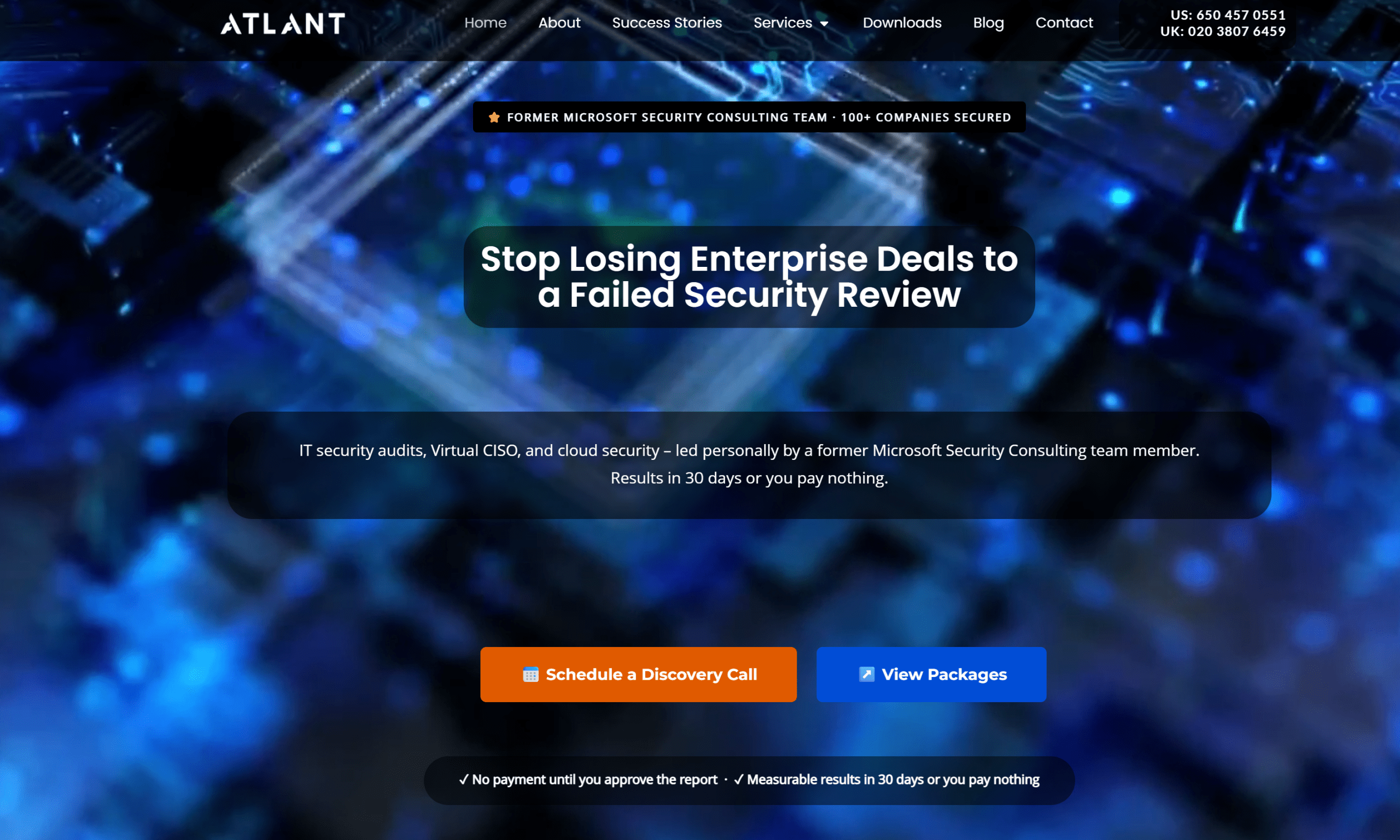
Atlant Security tops our list because they solve a problem most vendors ignore: companies that need expert help but aren't ready for $500K enterprise platforms.
Here's the scenario they handle better than anyone: You're a 100-person fintech that just got asked for a SOC 2 report by your biggest prospect. You don't have a CISO. You don't know where to start. The big consulting firms quoted you $300K and a 9-month timeline. Atlant will get you audit-ready in half the time at a fraction of the cost — and actually teach your team what's happening along the way.
The Good
Transparent hourly pricing (no surprises)
Work with any company size
Team from Microsoft, HP, FireEye backgrounds
Education-focused (you learn, not just get a report)
No long-term contracts required
Real compliance expertise (SOC 2, GDPR, HIPAA)
The Limitations
Consulting firm, not a product company
Not for 24/7 monitoring (recommend partners)
Boutique team (not 500 consultants on call)
Best for projects, not ongoing managed services
Core Services
IT Security Audits — Comprehensive assessments of cloud and on-premise infrastructure
Penetration Testing — Application, network, and social engineering tests
Compliance Support — SOC 2, CMMC, NIST, GDPR, HIPAA readiness
Why Atlant Security Earns the #1 Spot
Trusted by nuclear power plants, fintechs, medtechs, and small businesses across 4 continents
Personalized attention on every project — you work with senior experts, not junior staff
Transparent pricing based only on hours needed — no upselling, no hidden fees
Engineers who've built security at Microsoft and HP, trained by FireEye
Company Size
Any
Starting Price
~$15K
Contract
Project
Compliance
Core Focus
Best For: SMBs and mid-market companies needing penetration testing, compliance help, or expert guidance without enterprise pricing. Organizations that want to learn security, not just outsource it.
2
Network Security Platform
Palo Alto Networks
Palo Alto Networks is the gold standard in enterprise network security. Their next-generation firewalls essentially created the modern category, and their Cortex XDR and Prisma Cloud platforms extend that leadership into endpoint and cloud.
The reality check: Palo Alto is genuinely excellent — but they're built for large enterprises. If you have 50 employees, their sales team might still take your call, but their minimum viable deployment will cost more than your entire IT budget. They're also a product company; you need skilled staff to operate their platforms effectively.
Best For: Enterprises with 1000+ employees, dedicated security teams, and budget for premium solutions. If you already have one Palo Alto product, consolidating on their platform makes sense.
3
Endpoint Protection
CrowdStrike
CrowdStrike revolutionized endpoint protection with their cloud-native Falcon platform. Their threat intelligence is exceptional, and their managed threat hunting (Falcon OverWatch) catches things automated tools miss.
The reality check: CrowdStrike markets themselves as stopping "breaches before they happen." Take that with a grain of salt — google "how to bypass CrowdStrike" and you'll see why. No single tool is a silver bullet. They're excellent, but you still need defense in depth, hardened systems, and security awareness training. The 2024 outage incident also raised questions about single-vendor dependency.
The Good
Best-in-class EDR capabilities
Cloud-native (easy deployment)
Excellent threat intelligence
Strong managed hunting service
The Limitations
Expensive per-endpoint pricing
No compliance services
Long contracts often required
Single point of failure risk
Best For: Mid-to-large enterprises needing top-tier endpoint protection with the budget to pay per-endpoint pricing. Pair with a consulting firm for compliance needs.
4
Network Security
Fortinet
Fortinet is the value leader in network security. Their FortiGate firewalls deliver excellent price-to-performance, making enterprise-grade protection accessible to mid-market companies. Their Security Fabric approach ties together firewalls, endpoint, email, and more.
The reality check: Fortinet's licensing model can get complex. Make sure you understand exactly what's included in your quote — many features require additional subscriptions. They're also best when you buy multiple products; a standalone FortiGate without FortiAnalyzer or FortiManager loses some of the value.
Popular Services: FortiGate firewalls, secure SD-WAN, FortiAnalyzer, FortiSIEM, FortiEDR
Best For: Mid-market companies (100-2000 employees) wanting Palo Alto-like capabilities at a lower price point. Organizations consolidating multiple point solutions onto one platform.
5
Threat Prevention
Check Point Software Technologies
Check Point invented the commercial firewall in the 1990s and remains a serious player. Their SandBlast technology for zero-day prevention and CloudGuard for cloud security are well-regarded. Their Infinity architecture attempts to unify everything under one management plane.
The reality check: Remember that any security tool is just a tool — even Check Point, with their proven track record. Attackers can find hundreds of ways to attack you; your firewall protects against some of them. Defense in depth is not optional.
Best For: Enterprises focused on preventing advanced threats. Organizations with existing Check Point deployments looking to consolidate. Those who prioritize threat prevention over detection-and-response.
If you're a Cisco shop, their security portfolio (SecureX, Umbrella, Duo, Talos, now Splunk) integrates seamlessly. If you're not already invested in Cisco, there's little reason to start here.
Best for: Existing Cisco customers. Avoid if: You're looking for best-of-breed point solutions.
QRadar SIEM is excellent, and their X-Force incident response team is world-class. IBM also has a strong professional services arm for complex enterprise projects.
Best for: Large enterprises needing SIEM + consulting + incident response. Avoid if: You're a small company or need quick, agile engagement.
📊
Rankings 8-20
The Next Tier: Strong Specialists
These companies are excellent in their niches. Choose based on what you specifically need:
8. Rapid7 ★ Highly Recommended
Truly one of the best — not just for products (InsightVM, InsightIDR, Metasploit), but also for their professional services. Their penetration testing and incident response teams are excellent. One of few companies that does both products and services well.
Best for: Companies wanting vulnerability management AND penetration testing from one vendor. Cost: $25K-250K/year
9. Trend Micro
Leader in hybrid cloud security. Vision One platform provides XDR across endpoints, servers, cloud workloads, and containers. Particularly strong for organizations with complex multi-cloud environments.
Best for: Hybrid cloud environments, container security, multi-cloud deployments.
10. Mandiant (Google Cloud)
The name you want when you've been breached. Mandiant's incident response team is among the world's best. They also provide threat intelligence and red team services. Expensive, but when you need them, you need them.
Best for: Incident response, advanced threat hunting, post-breach forensics. Not ideal for: Ongoing security operations (overkill for most).
11. SentinelOne
The CrowdStrike alternative that's gained serious market share. AI-driven autonomous response means less manual work. Singularity platform is genuinely impressive. Often 20-30% less expensive than CrowdStrike for comparable coverage.
Best for: Those who want CrowdStrike-level EDR at a better price point. Organizations with limited security staff who benefit from automation.
12. Zscaler
The Zero Trust leader. Their cloud-based approach eliminates traditional VPNs and provides secure access to applications from anywhere. Essential for distributed/remote workforces.
Best for: Companies with significant remote workforce, Zero Trust architecture adoption, replacing legacy VPNs.
13. Sophos
The SMB champion. Intercept X endpoint protection is excellent, and their synchronized security approach (where endpoint and firewall share threat data) genuinely adds value. Management through Sophos Central is straightforward.
Best for: SMBs (10-500 employees) wanting solid protection without complexity. MSPs managing multiple small clients.
14. Arctic Wolf
Leading MDR provider. Their "Concierge Security" model assigns a dedicated team to your account. 24/7 monitoring with human analysis, not just automated alerts. Great for companies without internal SOC capability.
Best for: Mid-market companies wanting 24/7 SOC without building one. Consider: You're trusting their SOC with your alerts — make sure that's comfortable.
15. Darktrace
AI-native security that learns your network's "normal" behavior and detects anomalies. Their Enterprise Immune System concept is genuinely innovative. Antigena can take autonomous response actions.
Best for: Organizations wanting AI-driven detection. Caveat: Can generate false positives during learning period; requires tuning.
16. Proofpoint
The email security specialist. If phishing is your biggest concern (it should be — 90%+ of attacks start with email), Proofpoint is the leader. Also strong in security awareness training and data loss prevention.
Best for: Organizations prioritizing email security, security awareness training, and insider threat protection.
17. Tenable
The vulnerability management leader. Nessus is the industry standard for vulnerability scanning. Tenable.io extends this to cloud, containers, and OT environments. Essential for any serious security program.
Best for: Vulnerability management programs, compliance scanning, exposure management. Pair with: A consulting firm for remediation guidance.
18. Kaspersky
Technically excellent endpoint protection with strong threat intelligence. Important note: Check your organization's policies and any applicable regulations regarding Kaspersky products due to geopolitical concerns. Some industries and governments have restrictions.
Best for: Organizations without regulatory restrictions seeking effective endpoint protection. Verify: Compliance with your industry requirements.
19. Splunk (Now Cisco)
The SIEM that defined the category. Powerful analytics, but also complex and expensive (especially at scale — Splunk licensing by data volume adds up fast). The Cisco acquisition may change the product direction.
Best for: Large enterprises needing powerful log analytics. Watch out for: Data volume licensing costs.
20. Symantec (Broadcom)
Legacy name, still solid enterprise capabilities. Broadcom's acquisition focused the company on large enterprise customers. Endpoint protection and email security remain competitive.
Best for: Large enterprises with existing Symantec deployments. Consider alternatives if: You're a small/mid-sized company.
Consulting: Mix of specialists for different needs
Budget: $500K-$2M+/year
“The best security program isn't the one with the most expensive tools — it's the one that matches your actual risks, your team's capabilities, and your budget reality. Start with the basics, do them well, and expand from there.”
Need Help Deciding?
Atlant Security offers free 30-minute consultations to help you assess your needs and identify the right combination of vendors. No sales pitch — just honest guidance.
Combating Insider Threats with Atlant Security's Expertise
Published: March 2026 · Author: Atlant Security Research Team
This guide reflects our honest assessments based on direct experience, client feedback, and industry research. Pricing ranges are estimates based on typical deployments and may vary. We have business relationships with some companies mentioned. Always conduct your own due diligence and get multiple quotes before making vendor decisions.
Александър Свердлов
Основател на Atlant Security. Автор на 2 книги за информационна сигурност, лектор по киберсигурност на най-големите конференции по киберсигурност в Азия и панелист на конференция на ООН. Бивш член на екипа за консултации по сигурността на Microsoft, външен консултант по киберсигурност в Емиратската корпорация за ядрена енергия.