Киберсигурност за клиенти на частно банкиране: Защита на богатството срещу хакери
Alexander Sverdlov
Анализатор по сигурността

You know the risks. Do you know how to defend yourself?
We are noticing an alarming increase in both the number of attacks against private banking clients and the sophistication of these attacks. Hackers are rapidly adopting AI tools to generate convincing fake login pages and undetectable attack tools and scripts.
https://www.youtube.com/watch?v=6nGsDWEpeY8
As a private banking client, you enjoy exclusive financial services and tailored investment opportunities. But with your privilege comes an unfortunate reality - high-net-worth individuals are prime targets for cybercriminals.
Hackers, fraudsters, and even nation-state attackers (North Korea is known for executing a large number of financially motivated cyber attacks) are actively seeking to infiltrate private banking accounts, exploit security gaps, and steal assets. The question is not if you will be targeted, but when - and whether you will be prepared. It's easy math: when the hackers encounter resistance, they just move on to an easier target. Time is money!
Why Private Banking Clients Are High-Value Targets
Cybercriminals target private banking clients for one reason: opportunity.
High-Value Accounts: Even a single breach can result in millions of dollars in unauthorized transactions.
Multiple Financial Touchpoints: Wealthy individuals often have multiple accounts, investments, trusts, and advisors, creating a complex attack surface.
Exclusive Access to Investments: Cybercriminals seek inside information on private equity deals, IPOs, and confidential transactions.
Weaker Personal Security: Unlike corporate networks, personal devices, home networks, and private email accounts often lack enterprise-level cybersecurity. If you, for example, allow your computer to be used by your children, you expose all your credentials and bank account details to any teenage hacker willing to exploit the trust of your child to click on a simple malicious link...
The Most Common Cyber Threats Facing Private Banking Clients
1. Wire Fraud & Account Takeovers
Cybercriminals impersonate clients, bankers, or financial advisors to manipulate transactions. Once they gain access, they authorize fraudulent wire transfers that are often impossible to recover.
2. SIM Swapping & Mobile Banking Exploits
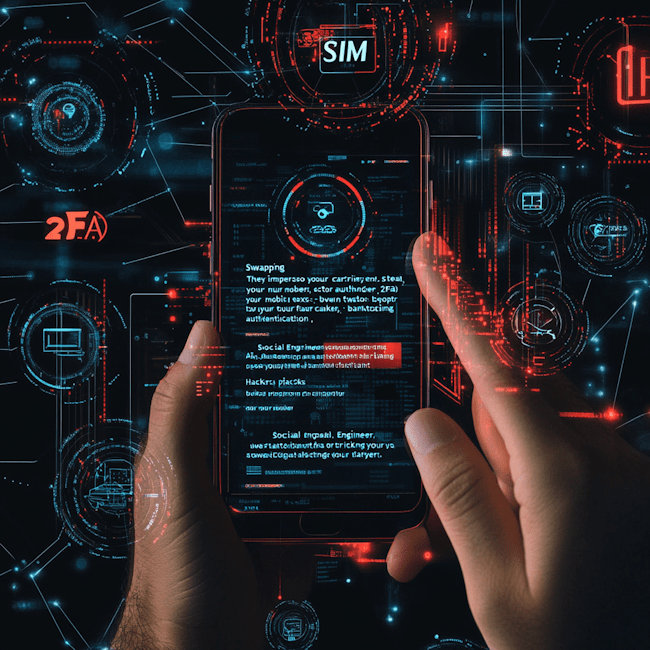
Hackers convince mobile providers to transfer your phone number to their device, allowing them to intercept SMS-based two-factor authentication (2FA) and take over banking accounts.
They can simply walk into any small office of your mobile provider and present a fake ID, claiming they lost a SIM and ask for a new one. From there it is a simple process of resetting your credentials everywhere where you've added your mobile phone as a verification option. Don't do that!
3. Phishing & Social Engineering Attacks
Highly targeted phishing emails, often appearing to be from your private banker or investment advisor, trick clients into revealing login credentials or approving fraudulent transactions.
You can even receive voice messages with a familiar voice - for example, of your personal banker - from their phone number! in Whatsapp or Telegram, asking you to click on a link or do something else, compromising your security and giving over access to your account.
4. Home Network & Device Compromises
Wealthy individuals often work from multiple locations, including homes, offices, and vacation properties. Unsecured home networks and smart devices provide easy entry points for attackers.
We can't even count the times we've seen accounts compromised after using the computers in hotel "business lounges". These devices are often infested with malware and sometimes even have hardware keyloggers in their keyboards.
5. Dark Web Exposure
Leaked personal data-such as past passwords, account details, and identity information-can be sold on the dark web and used in future cyberattacks.
It is as easy as just pasting a few of the email addresses you've ever used, anywhere - into a dark web underground tool. And voila, all the passwords you used on any website that was ever hacked, are displayed, for just a few dollars. (usually less than $10!).
It is incredibly easy to obtain one's passwords, even if you are a high net worth individual.
The Financial and Legal Consequences of a Cybersecurity Breach
For private banking clients, a cyber breach is not just a financial inconvenience-it can lead to devastating financial losses, regulatory scrutiny, and even reputational damage.
1. Irreversible Financial Losses
Unlike consumer banking, where fraud protection is standard, private banking transactions often involve high-value transfers with limited recourse.
2. Legal and Regulatory Risk
Certain financial institutions have strict compliance requirements, such as Know Your Customer (KYC) and Anti-Money Laundering (AML) protocols. If a cyber breach leads to unauthorized activity, the client could face legal complications.
3. Reputational Damage
For public figures, executives, and business leaders, a financial breach can erode trust and invite scrutiny from regulators, investors, and the media.
How Private Banking Clients Can Secure Their Wealth
Private banking clients must take a proactive approach to cybersecurity. Relying solely on the bank’s security measures is not enough. Here’s how to protect yourself:
1. Strengthen Banking & Financial Account Security
-
Use hardware security keys instead of SMS-based two-factor authentication.
-
Implement transaction verification controls with your private banker. When coming up with secret questions and answers, do not rely on real life information! Your first pet may just as well be the Starship Enterprise and your mother's maiden name may be Galaxy Andromeda. Why not? Don't make the hackers' lives easy!
-
Limit high-value transfers to pre-approved accounts only.
2. Protect Personal Devices & Communication Channels
-
Use a dedicated secure device for financial transactions, separate from daily-use devices. Keep that device up-to date, keep it safe, have a backup in case you lose it.
-
Encrypt all sensitive financial communications using secure email platforms.
-
Regularly scan for malware and spyware that could be tracking keystrokes or activity.
3. Harden Personal and Home Network Security
-
Use secure, hardened devices for all digital banking activity. What is a hardened device? For example, if you're using Windows, you might ask your IT to harden it following the Windows 11 STIG.
-
Implement segmented networks-one for smart home devices, another for financial transactions.
-
Conduct regular cybersecurity audits on your personal and business accounts. What should you check?
- How secure is the account
- Is the backup email account protected
4. Be Vigilant Against Social Engineering Attacks
-
Verify all financial instructions via a secondary authentication method (e.g., voice verification with your banker).
-
Never approve transactions based solely on email or text requests.
-
Train personal assistants, financial advisors, and family members on cyber risk awareness.
5. Monitor and Respond to Emerging Threats
-
Regularly monitor your accounts for unusual activity or unauthorized access.
-
Work with cybersecurity professionals who specialize in high-net-worth individual protection.
-
Use dark web monitoring services to check if your credentials have been compromised.
The Future of Private Banking Cybersecurity
The financial elite are now at the center of a new digital battlefield. Cybercriminals are evolving their tactics, and regulatory bodies are increasing pressure on banks to enforce tighter security measures.
The question is: Are private banking clients doing enough to secure themselves?
True wealth protection in the digital age is not just about financial management-it’s about digital resilience. By implementing advanced cybersecurity measures, securing personal accounts, and staying ahead of emerging threats, private banking clients can ensure that their wealth remains protected for generations to come.
The risk is real. The responsibility is personal. The solution? Proactive cybersecurity leadership.
Вижте също: Information Security Consultants Require Efficiency Controls To Be Effective

Александър Свердлов
Основател на Atlant Security. Автор на 2 книги за информационна сигурност, лектор по киберсигурност на най-големите конференции по киберсигурност в Азия и панелист на конференция на ООН. Бивш член на екипа за консултации по сигурността на Microsoft, външен консултант по киберсигурност в Емиратската корпорация за ядрена енергия.